03 - ASP.NET Core
A framework for building web apps and services with .NET and C#.
ASP.NET Core does several web technologies. We are going to focus on two - serverside HTML (MVC and Razor Pages) and web services (Web API).
ASP.NET Core MVC
MVC is a design pattern that separates the application into 3 components:
- Model - the data and business logic
- View - the UI
- Controller - the glue between the Model and View
Routing is the process of mapping a URL to a controller action. The routing engine parses the URL and matches it to a route. The route is then used to choose and execute the controller action.
Controller can have several actions. Each action can handle a different HTTP method (GET, POST, etc.) and different incoming url (route).
MVC
- MVC pattern is from SmallTalk team, first academic paper is from year 1979
- By the original definition
- MODEL – business info and logic
- VIEW – visual (partial) representation of model
- CONTROLLER – middle part in between user and system
- Derivatives: MVP, MVVM, ...
- MVC separates into Model, View, and Controller
- MVVM adds a ViewModel as an intermediary
- MVP introduces a Presenter to mediate interactions
- MVI adds Intent. Unidirectional data flow, immutable, reactive programming style
Modern web uses the same pattern – html as model, css as view and browser as controller
MVC Separation
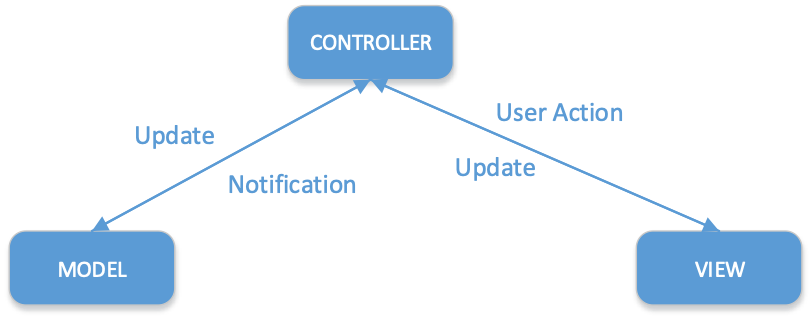
Why MVC?
- Separation of Concerns – business logic (model) and user interface (view) should be separated from each other. BL/Model represent our understanding of real world, UI is just for presentation and manipulation
- Business logic should be totally independent
- Business logic should be able to support several different UI-s
- Controller intermediates between BL (Model) and UI
ASP.NET Core Razor Pages
Razor Pages is a page-focused framework for building web UI. It combines the features of MVC with the simplicity of Razor Pages. Here one html with code-behind file servers one url and supports all the HTTP methods (GET, POST, etc.).
ASP.NET Core Web API
Web API is a framework for building HTTP services. It is a lightweight framework that is used to build RESTful services. Uses the same MVC pattern as ASP.NET Core MVC html - but output is serialized data over http protocol - JSON, XML, etc.
Scaffolding
After designing your domain models, you use scaffolding to generate the controller and views for your models.
Tooling (update or install):
dotnet tool update -g dotnet-ef
dotnet tool update -g dotnet-aspnet-codegenerator
Install packages:
- Microsoft.VisualStudio.Web.CodeGeneration.Design
- Microsoft.EntityFrameworkCore.Design
- Microsoft.EntityFrameworkCore.SqlServer
Razor pages
dotnet aspnet-codegenerator razorpage \
    -m <MODEL> \
    -outDir Pages/<MODEL in plural> \
    -dc AppDbContext \
    --useDefaultLayout \
    --referenceScriptLibraries \
    -f
MVC
dotnet aspnet-codegenerator controller \
    -name <MODEL in plural>Controller \
    -m <MODEL> \
    -actions \
    -dc AppDbContext \
    -outDir Areas/Admin/Controllers \
    --useDefaultLayout \
    --useAsyncActions \
    --referenceScriptLibraries \
    -f
Web API
dotnet aspnet-codegenerator controller \
    -name <MODEL in plural>Controller \
    -m <MODEL> \
    -actions \
    -dc AppDbContext \
    -outDir ApiControllers \
    -api \
    --useAsyncActions \
    -f
Initially use dbcontext in controllers, later we will swap it out with layered architecture - DAL, BLL, etc. (CLEAN/ONION architecture, then modular monolith, then microservices - architecture is the MAIN focus of this course).
Self preparation QA
Be prepared to explain topics like these:
- Why MVC as a pattern? — MVC separates business logic (Model), presentation (View), and user interaction handling (Controller). This separation lets you change the UI without touching business logic, and vice versa.
- What is the difference between MVC, Razor Pages, and Web API in ASP.NET Core? — MVC uses controllers with multiple actions and separate view files. Razor Pages combine a single page with its code-behind for simpler page-focused scenarios. Web API uses the same MVC pattern but returns serialized data instead of HTML.
- Why use scaffolding, and what are its limitations? — Scaffolding generates boilerplate CRUD controllers and views quickly. However, scaffolded code puts data access directly in controllers. You must refactor toward layered architecture as the project grows.
- Why start with DbContext in controllers and swap to layered architecture later? — Starting simple lets you learn the framework mechanics without the overhead of abstractions. Once you understand how controllers, model binding, and EF Core work together, adding layers makes sense.
- What are the derivatives of MVC (MVP, MVVM, MVI) and when do they apply? — MVP uses a Presenter for mediation (common in desktop). MVVM adds a ViewModel with two-way data binding (WPF, mobile). MVI uses unidirectional data flow with immutable state. The choice depends on the UI framework.